Lead Conversion
How Much Is a Missed Call Worth to a Home Service Company?
A missed call is not automatically a lost sale, but unanswered customer calls can carry a measurable opportunity cost. Here is how to estimate it responsibly.
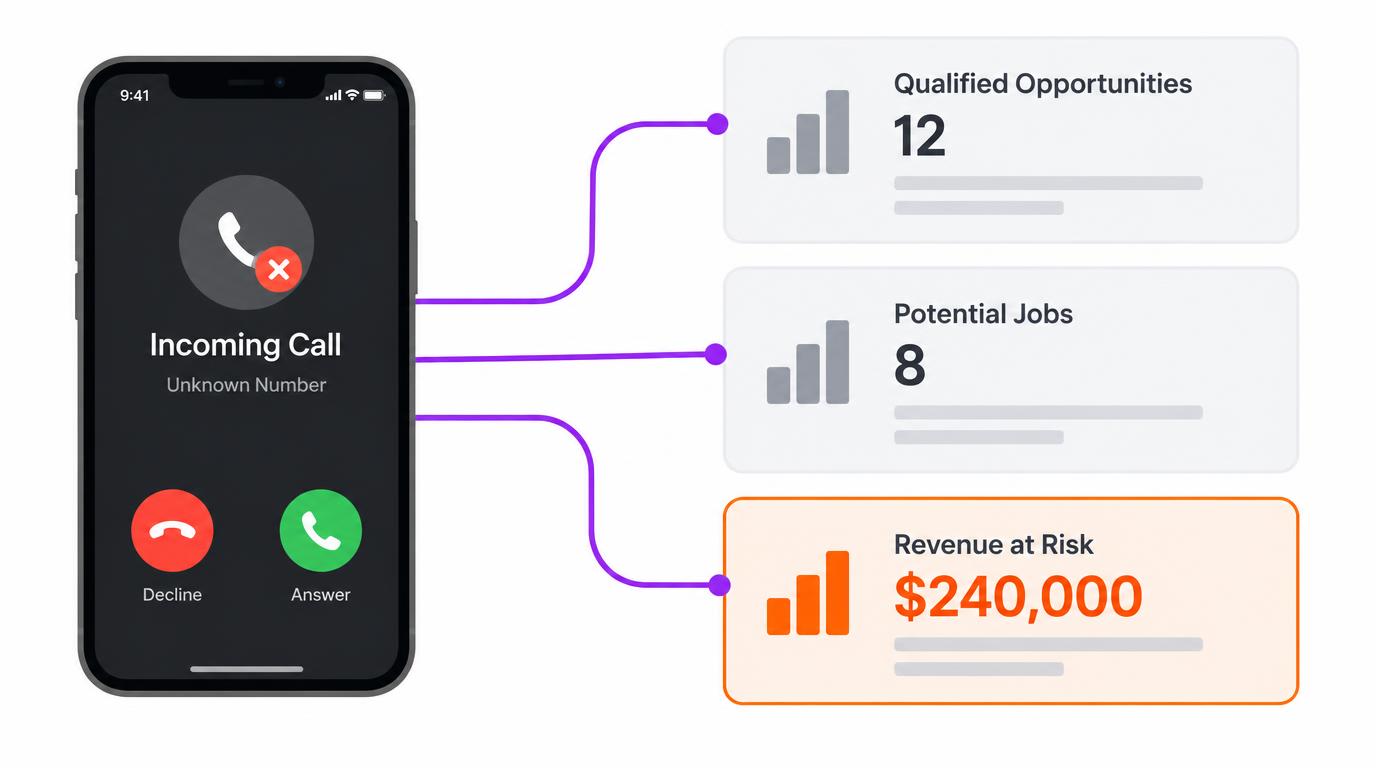
A missed call does not appear on a profit-and-loss statement. It does not arrive as an invoice. It may never be recorded as a lead.
That is what makes missed-call cost easy to underestimate.
When a homeowner needs a plumber, electrician, HVAC technician, garage-door company, or pest-control provider, calling is often the fastest path to help. If nobody answers, the caller may leave a message. The caller may also contact the next company.
Not every unanswered call would have become a job. Some calls are spam, vendors, current customers, wrong numbers, or people outside the service area. The right question is not, “Is every missed call lost revenue?”
The useful question is, “How many missed calls are legitimate opportunities, and what could those opportunities be worth?”
Start with missed calls, not assumptions
The first step is establishing a baseline.
Review at least several weeks of call activity and identify:
- Calls that rang without an answer
- Calls received after hours
- Calls received while the team was already on another call
- Calls abandoned before voicemail
- Calls transferred but never connected
- Repeat attempts from the same caller
Be careful not to count three calls from the same person as three separate opportunities. The goal is to estimate missed customer conversations, not inflate the number.
If your current phone reporting is limited, begin with a reasonable weekly estimate and improve it as better information becomes available.
Four numbers create a useful estimate
A practical missed-call calculation needs four inputs:
- Missed calls per week
- Percentage that are legitimate customer opportunities
- Typical close rate for qualified callers
- Average revenue from a completed job
The calculation is:
Potential weekly revenue at risk =
Missed calls per week
× legitimate opportunity percentage
× typical close rate
× average completed-job revenue
Monthly estimates should use the average number of weeks in a month:
Average weeks per month = 52 ÷ 12
Annual estimates use 52 weeks.
The result is potential revenue at risk, not guaranteed lost revenue.
An illustrative example
Consider a home service company that estimates:
- 10 missed calls per week
- 60 percent are legitimate customer opportunities
- 35 percent of qualified callers normally become customers
- $750 average completed-job revenue
The calculation produces:
- 6 qualified opportunities missed per week
- 2.1 potential jobs at risk per week
- $1,575 in potential weekly revenue at risk
- $6,825 in potential monthly revenue at risk
- $81,900 in potential annual revenue at risk
Those numbers do not mean the company definitely lost $81,900. They show what the entered assumptions produce. Actual results depend on call quality, availability, pricing, service area, competition, booking performance, and job completion.
That distinction matters. A useful calculator should create clarity, not manufacture urgency.
Average job value can change the picture quickly
Missing one small repair and missing one replacement opportunity are not financially equivalent.
Some businesses use one overall average job value. Others benefit from separating calls into categories, such as:
- Repair
- Maintenance
- Installation
- Replacement
- Emergency service
- Commercial inquiry
For an initial estimate, one blended average keeps the calculation simple. For operational planning, reviewing call types separately can reveal where coverage matters most.
Use revenue collected from completed work, not the largest possible ticket. Choosing an unusually high number makes the estimate less credible.
Close rate should reflect real conversations
The close-rate input should represent what happens when your company actually speaks with a qualified caller.
Do not use the percentage of all calls that become jobs if that number includes spam, vendors, and current-customer questions. Do not use a best-ever month as the normal rate.
If you do not track close rate, begin with a conservative estimate. You can refine it by comparing qualified conversations, booked appointments, estimates, and completed jobs.
The purpose is not to produce the biggest result. It is to identify whether missed calls are important enough to fix.
Why home service calls go unanswered
Missed calls are not always a staffing failure. They often reflect the reality of field service.
Common reasons include:
- Technicians are driving or working with customers.
- Office staff are handling another caller.
- Calls arrive during lunch, evenings, or weekends.
- Seasonal demand creates sudden spikes.
- The owner is both selling and completing work.
- Calls route to the wrong person.
- The team assumes voicemail will be enough.
- The business has no consistent overflow process.
The solution is not necessarily hiring another full-time employee. It is creating a coverage plan that matches call volume, hours, service types, and customer expectations.
The first response does not need to solve everything
Customers usually need acknowledgment and a clear next step.
An effective initial response may:
- Confirm that the request was received
- Identify the service needed
- Collect the caller’s name and location
- Determine whether the request fits the service area
- Recognize urgent safety issues and escalate appropriately
- Request an appointment or callback window
- Route the information to the right person
The first response should not provide unapproved technical advice, make promises about arrival times, or quote prices the business has not authorized.
Where an AI phone receptionist can help
An AI phone receptionist can provide coverage when the team cannot answer. It can follow approved business rules, collect information, respond to common questions, and route the opportunity.
Potential uses include:
- After-hours answering
- Overflow coverage
- Basic qualification
- Service-area confirmation
- Appointment requests
- Call summaries
- Human transfer based on defined rules
AI should not be treated as a replacement for every human conversation. Some situations require judgment, empathy, technical knowledge, or immediate escalation.
A responsible setup defines:
- What the system may say
- What it must not say
- When to transfer
- When to collect a callback request
- How to handle emergencies
- Which services and locations qualify
- Who receives each lead
- How failed transfers are handled
The system should support the business process rather than create another complicated system employees must monitor.
Track outcomes, not just answered calls
Answer rate matters, but it is not the final measure.
Track:
- Total inbound calls
- Unique callers
- Missed calls
- Qualified opportunities
- Appointments requested
- Appointments booked
- Transfers completed
- Leads delivered
- Completed jobs
- Revenue associated with tracked opportunities
- Opt-outs and customer complaints
A system can answer every call and still perform poorly if it collects bad information or routes leads incorrectly.
Review both the customer experience and the business result.
A practical improvement plan
Step 1: Measure one normal month
Establish how many calls arrive, when they arrive, and how many unique customer opportunities go unanswered.
Step 2: Identify coverage gaps
Look for patterns involving lunch, after hours, weekends, peak season, specific employees, and transfer failures.
Step 3: Define the approved response
Document service areas, hours, services, FAQs, transfer rules, appointment rules, and escalation situations.
Step 4: Start with a controlled use case
After-hours or overflow coverage is often easier to test than changing the entire phone experience at once.
Step 5: Review recordings and outcomes
Check whether callers are understood, information is accurate, transfers work, and the team follows up.
Step 6: Improve the process
Refine questions, routing, instructions, and escalation based on real calls.